country
Spain
From copla and flamenco to Rosalía and Quevedo, seven decades of Spanish sound
Listen through Spain
5 defining tracks in the order they were released, from 1967 to 1988, each with a line on why it matters.
Preview: plays 5 of 16 tracks.
- 1960s
- 1970s
- 1980s
30-second previews, streamed from Apple.
The Hitlist
The defining tracks from this region
Preview: 5 of 16 tracks
Mediterráneo
Joan Manuel SerratJoan Manuel Serrat is one of the most beloved singer-songwriters in the Spanish-speaking world, singing in both Catalan and Spanish. He rose through the Catalan Nova Cançó movement in the 1960s and became a symbol of dignity during the late Franco years. His albums setting the poems of Antonio Machado and Miguel Hernández to music are cornerstones of the canción de autor tradition. Songs like Mediterráneo remain unofficial anthems across Spain and Latin America.
Spain's music runs on passion and reinvention. Andalusian copla and flamenco gave the country its dramatic heart through icons like Lola Flores, Paco de Lucía, and Camarón de la Isla, while balada stars like Julio Iglesias and Raphael conquered the world. After Franco, La Movida set 1980s Madrid alight with synth-pop, singer-songwriters like Serrat and Sabina became the nation's conscience, and rock and nuevo flamenco carved out new ground. Today artists like Rosalía, C. Tangana, and Quevedo take that heritage and reframe it as cutting-edge global pop.
Frequently Asked Questions
What is the most famous type of music from Spain?+
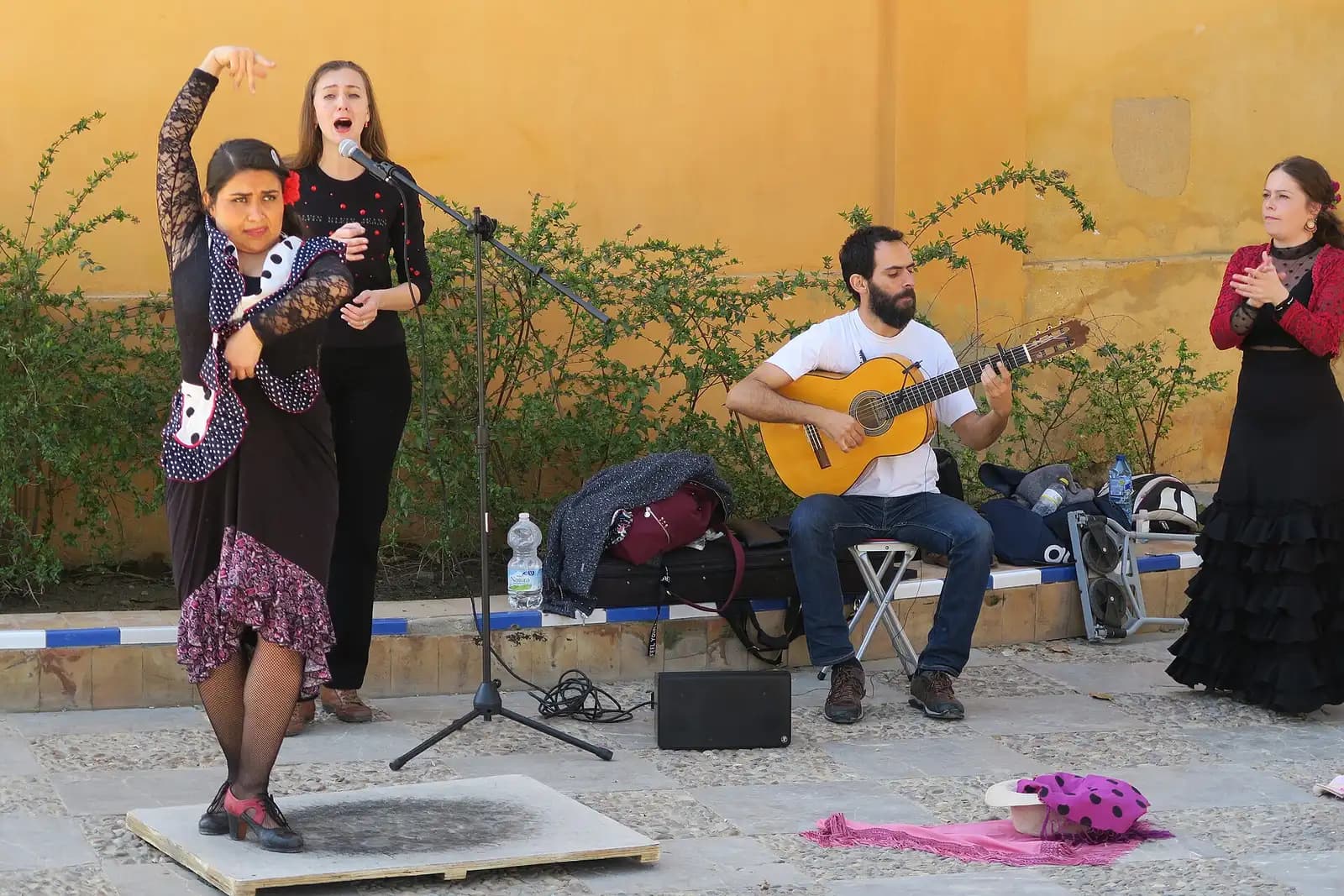
Flamenco is Spain's most iconic musical tradition, born in the Andalusian regions of the south from Romani, Moorish, and Spanish folk roots. It combines passionate singing (cante), virtuosic guitar, handclaps, and dance, and was recognised by UNESCO as Intangible Cultural Heritage in 2010. Beyond flamenco, Spain has a rich pop, rock, and singer-songwriter tradition.
Who are the most important flamenco musicians in Spain?+
Guitarist Paco de Lucía and singer Camarón de la Isla are the two towering figures of modern flamenco, and their partnership transformed the art form. Enrique Morente pushed flamenco toward the avant-garde, while nuevo flamenco acts like Ketama and Niña Pastori brought it to pop audiences. More recently, Rosalía has reframed flamenco for the global pop era.
What was La Movida Madrileña?+
La Movida Madrileña was a countercultural explosion of music, art, and film that swept Madrid after the death of dictator Francisco Franco in 1975. It celebrated newfound freedom with punk energy, synth-pop, and pop art, and defined the sound of 1980s Spain. Bands like Mecano, Radio Futura, and Alaska y Dinarama were among its most famous voices.
Who are the biggest Spanish pop and urban artists today?+
Rosalía is Spain's most acclaimed contemporary artist, blending flamenco with trap and global pop and winning multiple Grammy and Latin Grammy Awards. C. Tangana is another leading figure, fusing urban music with flamenco and bolero. In mainstream pop, Alejandro Sanz, David Bisbal, and Pablo Alborán remain major stars, while Bad Gyal leads the dancehall-influenced urbano scene.
Last reviewed: 2026-07
What languages do Spanish artists sing in?+
Most Spanish artists sing in Spanish (Castilian), the country's official language. However, several sing in Spain's co-official languages, especially Catalan, as heard in the work of Lluís Llach and parts of Joan Manuel Serrat's catalogue. This linguistic diversity is an important part of Spain's musical identity.
Sources & References
- 1Flamenco: Passion, Politics and Popular Culture — William Washabaugh, 1996Book
- 2Spain: A History in Music — BBC Music, 2021
- 3Rosalía: how a flamenco scholar became a global pop star — The Guardian, 2019
- 4La Movida: the wild youth culture that transformed Spain — BBC Culture, 2020
- 5Flamenco - UNESCO Intangible Cultural Heritage — UNESCO, 2010
Further Reading
About This Article
This page is based on documented music history, artist biographies, chart data, award records, and cross-referenced sources from music journalism and academic research.
Curated by the timeline.music editorial team.
▸Read the timeline as text
The sound of Spain, decade by decade: 9 genres and 32 artists, from the 1950s to the 2020s.
- 1950s
- Copla with Lola Flores.
- 1960s
- Copla with Lola Flores; Flamenco with Paco de Lucía and Camarón de la Isla; Canción de Autor with Joan Manuel Serrat and Lluís Llach; Balada with Raphael and Rocío Dúrcal; Rock Español with Miguel Ríos.
- 1970s
- Copla with Lola Flores and Rocío Jurado; Flamenco with Paco de Lucía, Camarón de la Isla and Enrique Morente; Canción de Autor with Joan Manuel Serrat, Lluís Llach and Joaquín Sabina; Balada with Raphael, Julio Iglesias and Rocío Dúrcal; Rock Español with Miguel Ríos and Triana; Nuevo Flamenco with Kiko Veneno.
- 1980s
- Copla with Lola Flores and Rocío Jurado; Flamenco with Paco de Lucía, Camarón de la Isla and Enrique Morente; Canción de Autor with Joan Manuel Serrat, Lluís Llach and Joaquín Sabina; Balada with Raphael, Julio Iglesias and Rocío Dúrcal; La Movida Madrileña with Mecano, Radio Futura and Alaska; Rock Español with Miguel Ríos, Triana and Héroes del Silencio; Nuevo Flamenco with Kiko Veneno, Pata Negra and Ketama.
- 1990s
- Copla with Lola Flores, Rocío Jurado and Los del Río; Flamenco with Paco de Lucía, Camarón de la Isla and Enrique Morente; Canción de Autor with Joan Manuel Serrat, Lluís Llach and Joaquín Sabina; Balada with Raphael, Julio Iglesias and Rocío Dúrcal; La Movida Madrileña with Mecano, Radio Futura and Alaska; Rock Español with Miguel Ríos, Héroes del Silencio, Los Planetas and Extremoduro; Nuevo Flamenco with Kiko Veneno, Pata Negra, Ketama and Niña Pastori; Pop Español with Alejandro Sanz and Enrique Iglesias.
- 2000s
- Copla with Rocío Jurado and Los del Río; Flamenco with Paco de Lucía and Enrique Morente; Canción de Autor with Joan Manuel Serrat, Lluís Llach and Joaquín Sabina; Balada with Raphael, Julio Iglesias and Rocío Dúrcal; La Movida Madrileña with Alaska; Rock Español with Miguel Ríos, Héroes del Silencio, Los Planetas and Extremoduro; Nuevo Flamenco with Kiko Veneno, Ketama and Niña Pastori; Pop Español with Alejandro Sanz, David Bisbal and Enrique Iglesias.
- 2010s
- Flamenco with Paco de Lucía; Canción de Autor with Joan Manuel Serrat and Joaquín Sabina; Balada with Raphael; Rock Español with Miguel Ríos, Los Planetas and Extremoduro; Nuevo Flamenco with Kiko Veneno and Niña Pastori; Pop Español with Alejandro Sanz, David Bisbal, Pablo Alborán and Enrique Iglesias; Urbano Español with Rosalía, C. Tangana and Bad Gyal.
- 2020s
- Balada with Raphael; Nuevo Flamenco with Niña Pastori; Pop Español with Alejandro Sanz, David Bisbal and Pablo Alborán; Urbano Español with Rosalía, C. Tangana, Bad Gyal and Quevedo.