country
Iran
Poetry and the radif, guitars in 1970s Tehran, rap without permission, and voices in exile
Top 10 Hitlist
The defining tracks from this region
Gol-e Yakh
Kourosh YaghmaeiThe central figure of Iranian psychedelic rock, who set Persian melody and santur-derived lines against fuzz guitar and phaser in the years before the revolution. Gol-e Yakh, released in 1973, is the record that made his name and remains one of the most recognisable Iranian songs. He was banned from releasing music for more than two decades afterwards. A 2011 reissue on Now-Again introduced his 1970s work to listeners outside Iran.
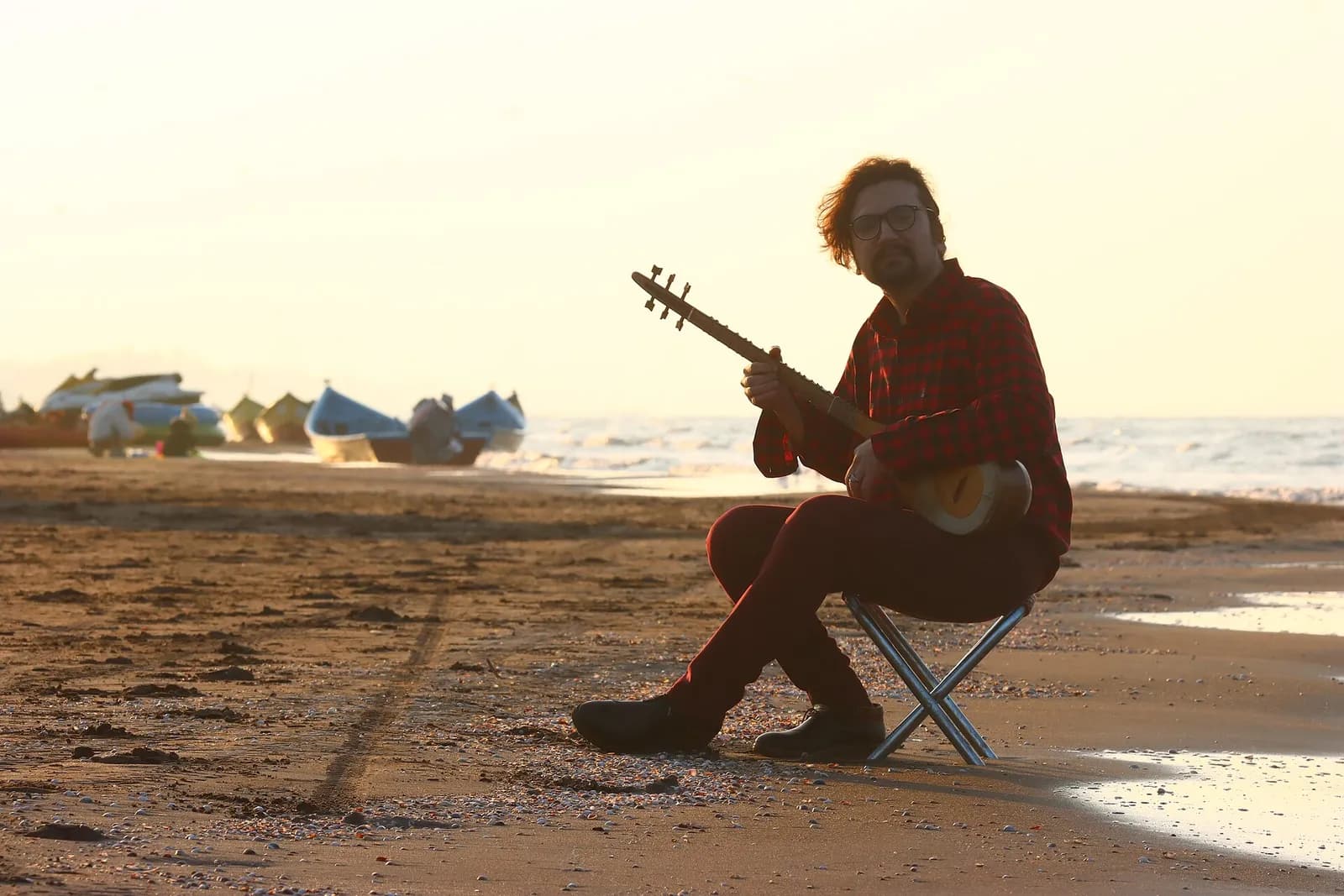
Iranian music runs on two clocks. One is the radif, the classical repertoire of twelve dastgah that singers and instrumentalists learn by heart and improvise from, setting Hafez and Rumi, and which Mohammad Reza Shajarian carried for half a century. The other is popular music, which Vigen started with a guitar in 1954 and Googoosh took to a scale no Iranian artist had reached. The 1979 revolution cut that second line in two: women were barred from singing solo in public, much of the industry moved to Los Angeles, and what stayed had to be licensed. Rap grew underground in 2000s Tehran without venues or permission, regional traditions from Kurdistan to the Gulf coast continued on their own terms, and in 2022 a song assembled from protest tweets became the most heard Iranian record in decades.
Frequently Asked Questions
What music is Iran known for?+
Two very different traditions. Persian classical music is built on the radif, a repertoire of melodic models grouped into twelve dastgah that musicians learn by heart and improvise from, usually setting classical poetry by Hafez, Rumi or Saadi. Alongside it is popular music: Vigen started Persian pop with a guitar in 1954, Googoosh made it enormous in the 1970s, and rock, rap and electronic music have all followed. Iran is also home to distinct regional traditions, including Kurdish, Azeri, Baluchi, Turkmen and the Gulf-coast music of Bushehr.
What changed for Iranian music after 1979?+
Almost everything about how it could be made and heard. Women were barred from singing solo to a general audience, a restriction that still stands, which is why Googoosh did not sing in public for twenty-one years and why singers like Marjan Vahdat record abroad. Much of the pop industry relocated to Los Angeles, where the Taraneh and Caltex labels kept it alive on cassette for listeners inside Iran. Music made domestically requires official permission, so a large amount of what gets made circulates unofficially instead.
Who was Mohammad Reza Shajarian?+
The defining voice of Persian classical music for around half a century, and a national figure well beyond music. His 1979 recording of the Ramadan prayer Rabbana was broadcast on state radio every year for three decades. In 2009 he sided with protesters and asked that his voice no longer be used by the state, and the broadcast stopped. He largely stopped performing in Iran after that, and his death in 2020 brought crowds into the street.
Is there a rap scene in Iran?+
Yes, and it has operated almost entirely without official permission since it started in 2000s Tehran. Hichkas is generally called its founder, and his records are built on Iranian melodic material rather than imported beats. Because the scene cannot get licences, venues or legal distribution, it grew through file sharing and now through streaming from abroad. Several of its best-known figures live outside the country.
Last reviewed: 2026-09
Why does this page separate Iranian and Persian music?+
Because they are not the same thing. Persian is the majority language and the one most of this catalogue is sung in, but Iran also includes Kurdish, Azeri, Baluchi, Turkmen, Luri, Gilaki and Arab communities with their own repertoires and musical systems. The Kamkars perform Kurdish music from Sanandaj, and Saeid Shanbehzadeh plays the ney anban of the Gulf coast, where centuries of trade left audible African and Indian traces. Treating all of it as Persian music would flatten most of the country.
Sources & References
- 1Music of Iran — Wikipedia contributors, 2026
- 2Soundtrack of the Revolution: The Politics of Music in Iran — Nahid Siamdoust, 2017Book
- 3Mohammad-Reza Shajarian — Wikipedia contributors, 2026
- 4How a song became the anthem of Iran's protests — Pitchfork, 2022
- 5Googoosh — Wikipedia contributors, 2026
- 6Kourosh Yaghmaei — Wikipedia contributors, 2026
Further Reading
About This Article
This page is based on documented music history, label catalogues and artist biographies. Iranian music is not synonymous with Persian-language music, and regional traditions and diaspora connections are identified rather than merged. For pre-1979 recordings, streaming carries reissues and compilations rather than originals, so years are given as the documented original release or performance year. Every linked recording was checked against the uploading channel and confirmed playable before publication.
Curated by the timeline.music editorial team.
▸Read the timeline as text
The sound of Iran, decade by decade: 6 genres and 26 artists, from the 1950s to the 2020s.
- 1950s
- Persian Pop with Vigen.
- 1960s
- Persian Classical with Mohammad Reza Shajarian; Persian Pop with Vigen, Googoosh, Hayedeh, Ebi and Mahasti; Persian Rock with Farhad Mehrad and Kourosh Yaghmaei.
- 1970s
- Persian Classical with Mohammad Reza Shajarian and Hossein Alizadeh; Persian Pop with Vigen, Googoosh, Hayedeh, Ebi, Mahasti and Dariush; Persian Rock with Farhad Mehrad, Kourosh Yaghmaei and Faramarz Aslani.
- 1980s
- Persian Classical with Mohammad Reza Shajarian, Hossein Alizadeh and Kayhan Kalhor; Persian Pop with Vigen, Hayedeh, Ebi, Mahasti and Dariush; Persian Rock with Farhad Mehrad, Kourosh Yaghmaei and Faramarz Aslani; Iranian Regional Music with The Kamkars.
- 1990s
- Persian Classical with Mohammad Reza Shajarian, Hossein Alizadeh, Kayhan Kalhor and Homayoun Shajarian; Persian Pop with Vigen, Ebi, Mahasti and Dariush; Persian Rock with Farhad Mehrad and Faramarz Aslani; Iranian Regional Music with The Kamkars and Saeid Shanbehzadeh; Iranian Alternative with Sote.
- 2000s
- Persian Classical with Mohammad Reza Shajarian, Hossein Alizadeh, Kayhan Kalhor and Homayoun Shajarian; Persian Pop with Googoosh, Ebi, Mahasti, Dariush, Mohsen Chavoshi and Mohsen Yeganeh; Persian Rock with Kourosh Yaghmaei and Faramarz Aslani; Persian Hip-Hop with Hichkas and Yas; Iranian Regional Music with The Kamkars, Saeid Shanbehzadeh and Marjan Vahdat; Iranian Alternative with Sote and Mohsen Namjoo.
- 2010s
- Persian Classical with Mohammad Reza Shajarian, Hossein Alizadeh, Kayhan Kalhor and Homayoun Shajarian; Persian Pop with Googoosh, Ebi, Dariush, Mohsen Chavoshi and Mohsen Yeganeh; Persian Rock with Kourosh Yaghmaei and Faramarz Aslani; Persian Hip-Hop with Hichkas and Yas; Iranian Regional Music with The Kamkars, Saeid Shanbehzadeh and Marjan Vahdat; Iranian Alternative with Sote, Mohsen Namjoo, Sevdaliza, Marjan Farsad and Saba Alizadeh.
- 2020s
- Persian Classical with Hossein Alizadeh, Kayhan Kalhor and Homayoun Shajarian; Persian Pop with Googoosh, Ebi, Mohsen Chavoshi, Mohsen Yeganeh and Shervin Hajipour; Persian Rock with Kourosh Yaghmaei and Faramarz Aslani; Persian Hip-Hop with Hichkas and Yas; Iranian Regional Music with The Kamkars, Saeid Shanbehzadeh and Marjan Vahdat; Iranian Alternative with Sote, Mohsen Namjoo, Sevdaliza, Marjan Farsad and Saba Alizadeh.