country
Trinidad & Tobago
Calypso, the steelpan, chutney and soca: four world traditions from two small islands
Top 10 Hitlist
The defining tracks from this region
Differentology
Bunji GarlinThe Viking of soca, known for a rapid-fire delivery closer to dancehall than to the tents, and the artist who took the form furthest internationally this century. Differentology, released in 2012 and remixed by Major Lazer, reached audiences soca had never held and won a Soul Train award. He is married to Fay-Ann Lyons, making them the genre's most formidable household. His writing keeps a harder political edge than most road music.
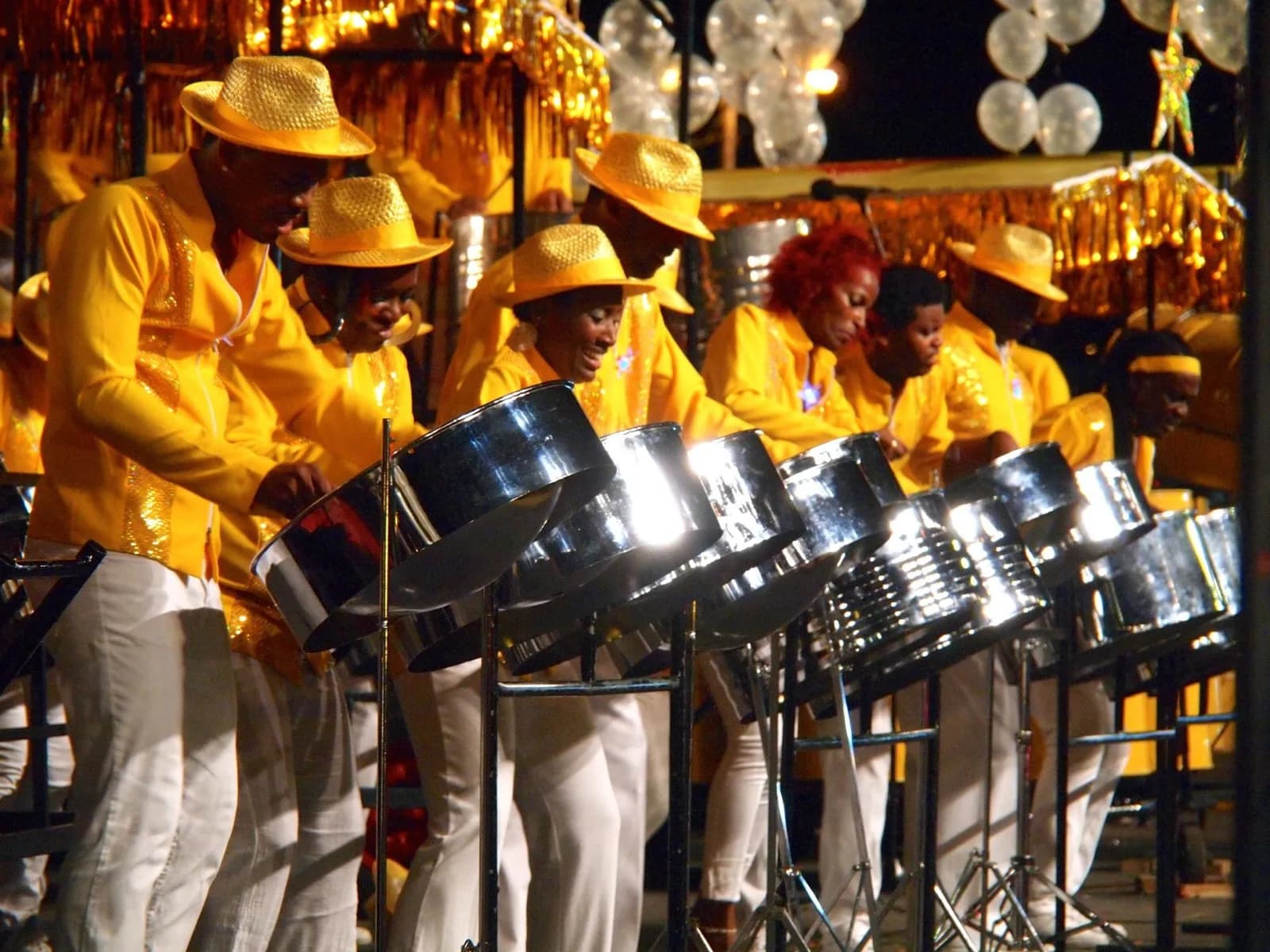
Trinidad and Tobago has produced more music per square mile than almost anywhere. Calypso came first, sung in the tents before Carnival and judged in competition, with Mighty Sparrow's Jean and Dinah in 1956 as its most famous record. The steelpan was built here from discarded oil drums in the 1930s and 40s, the only acoustic instrument invented in the twentieth century, and rival neighbourhood bands still meet each Carnival at Panorama. Lord Shorty folded Indo-Trinidadian rhythm into calypso in the early 1970s and produced soca, now the region's dominant dance music. Chutney carries the songs of indentured labourers brought from India, parang keeps a Spanish colonial Christmas alive, and rapso set poetry against rhythm. All of it runs on the same annual clock, pointed at Carnival.
Frequently Asked Questions
What music is Trinidad and Tobago known for?+
Four traditions of world significance, all of them local. Calypso is the topical song form sung in tents before Carnival and judged for the Calypso Monarch crown. The steelpan was built here from discarded oil drums in the 1930s and 40s and is the only acoustic instrument invented in the twentieth century. Soca, created by Lord Shorty in the early 1970s, is now the dominant Carnival dance music of the Caribbean. Chutney carries the music of indentured labourers brought from India, and parang and rapso complete the picture.
Who invented soca?+
Lord Shorty, born Garfield Blackman, in the early 1970s. He folded the dholak and dhantal rhythms of Indo-Trinidadian music into calypso looking for a sound that belonged to the whole island rather than one part of it, and called it the soul of calypso before the name contracted to soca. Endless Vibrations, released in 1974, is the record usually named as the start. He later renounced the Carnival music he had built, took the name Ras Shorty I and made devotional jamoo instead. His granddaughter Nailah Blackman is a leading soca artist today.
What is Panorama?+
The national steelband competition held each Carnival, and the event that drives the entire steelpan art form. Rival neighbourhood orchestras of up to a hundred players, such as Desperadoes, Renegades and Phase II Pan Groove, arrange a calypso or soca tune and perform it at the Queen's Park Savannah in Port of Spain. Arrangers like Jit Samaroo, Clive Bradley and Len Boogsie Sharpe are as celebrated as any singer. Because pan is a competition music rather than a studio one, Panorama performances are the recordings that count.
What is the difference between calypso and soca?+
Calypso is older and word-led: topical, often satirical commentary sung in the tents and judged on lyrics as much as melody. Soca grew out of it in the 1970s and is body-led, built for the road and for dancing, with the lyrics serving the rhythm rather than the other way round. In practice the two overlap constantly, and many artists work in both. The annual Road March title, awarded to the song played most often on the road at Carnival, is the prize soca is written for.
Is Carnival the centre of the music?+
Almost entirely. Soca and steelband records are written for a specific Carnival season and released in the weeks before it, and the calendar of Soca Monarch, Panorama and Road March shapes what gets made each year. The two Carnivals cancelled during the pandemic effectively removed two release years from the music. Chutney soca has its own Monarch competition, and parang belongs to Christmas rather than Carnival, but the annual clock governs most of what happens.
Last reviewed: 2026-09
Sources & References
- 1Music of Trinidad and Tobago — Wikipedia contributors, 2026
- 2Calypso: subject guide — National Library of Trinidad and Tobago, 2024
- 3Steelpan — Wikipedia contributors, 2026
- 4Soca music — Wikipedia contributors, 2026
- 5Chutney music — Wikipedia contributors, 2026
- 6Lord Shorty — Wikipedia contributors, 2026
Further Reading
About This Article
This page is based on documented music history, competition records for Calypso Monarch, Road March and Panorama, label catalogues and artist biographies. Years for archival calypso come from documented original release and competition years rather than from streaming reissue dates or video uploads. Every linked recording was checked against the uploading channel and confirmed playable before publication.
Curated by the timeline.music editorial team.
▸Read the timeline as text
The sound of Trinidad & Tobago, decade by decade: 7 genres and 24 artists, from the 1950s to the 2020s.
- 1950s
- Calypso with Mighty Sparrow and Lord Kitchener.
- 1960s
- Calypso with Mighty Sparrow, Lord Kitchener and Calypso Rose; Steelband with Desperadoes Steel Orchestra and BP Renegades Steel Orchestra; Chutney with Sundar Popo.
- 1970s
- Calypso with Mighty Sparrow, Lord Kitchener and Calypso Rose; Steelband with Desperadoes Steel Orchestra, BP Renegades Steel Orchestra and Phase II Pan Groove; Chutney with Sundar Popo; Parang with Daisy Voisin; Rapso with Brother Resistance; Early Soca with Lord Shorty and Shadow.
- 1980s
- Calypso with Mighty Sparrow, Lord Kitchener, Calypso Rose, David Rudder and Denyse Plummer; Steelband with Desperadoes Steel Orchestra, BP Renegades Steel Orchestra and Phase II Pan Groove; Chutney with Sundar Popo, Drupatee and Rikki Jai; Parang with Daisy Voisin; Rapso with Brother Resistance; Early Soca with Lord Shorty and Shadow; Soca with Superblue and Machel Montano.
- 1990s
- Calypso with Mighty Sparrow, Lord Kitchener, Calypso Rose, David Rudder and Denyse Plummer; Steelband with Desperadoes Steel Orchestra, BP Renegades Steel Orchestra and Phase II Pan Groove; Chutney with Sundar Popo, Drupatee and Rikki Jai; Parang with Daisy Voisin; Rapso with Brother Resistance; Early Soca with Lord Shorty and Shadow; Soca with Superblue, Machel Montano and Farmer Nappy.
- 2000s
- Calypso with Mighty Sparrow, Calypso Rose, David Rudder and Denyse Plummer; Steelband with Desperadoes Steel Orchestra, BP Renegades Steel Orchestra and Phase II Pan Groove; Chutney with Drupatee and Rikki Jai; Rapso with Brother Resistance; Early Soca with Shadow; Soca with Superblue, Machel Montano, Farmer Nappy, Destra Garcia, Bunji Garlin, Fay-Ann Lyons, Kes and Patrice Roberts.
- 2010s
- Calypso with Calypso Rose, David Rudder and Denyse Plummer; Steelband with Desperadoes Steel Orchestra, BP Renegades Steel Orchestra and Phase II Pan Groove; Chutney with Drupatee and Rikki Jai; Rapso with Brother Resistance; Early Soca with Shadow; Soca with Superblue, Machel Montano, Farmer Nappy, Destra Garcia, Bunji Garlin, Fay-Ann Lyons, Kes, Patrice Roberts and Nailah Blackman.
- 2020s
- Calypso with Calypso Rose and David Rudder; Steelband with Desperadoes Steel Orchestra, BP Renegades Steel Orchestra and Phase II Pan Groove; Soca with Machel Montano, Farmer Nappy, Destra Garcia, Bunji Garlin, Fay-Ann Lyons, Kes, Patrice Roberts and Nailah Blackman.