country
Greenland
Kalaallit Nunaat: rock that argued for home rule, and a language that never left the microphone
Top 10 Hitlist
The defining tracks from this region
Tupilak
TarrakRapper and artist from Nuuk who became the most visible Greenlandic musician of his generation. Tupilak, released in 2016, took the name of a carved figure from Greenlandic tradition and set it against modern production, and the video circulated far beyond the island. He works in Greenlandic almost exclusively and has used the platform to argue about colonial history and language. Releases have continued steadily, with Ua in 2024 and Pigalugu in 2025.
Greenlandic popular music starts at a precise point. In 1973 the band Sumé released Sumut, the first rock album sung in Greenlandic, attacking Danish colonial rule while Denmark still governed the island, and roughly one in five Greenlanders bought a copy. Everything since has been measured against it: Rasmus Lyberth's five decades of Greenlandic-language song, Nuuk Posse putting the language into hip-hop from the mid 1980s, Nanook carrying it to the widest audience yet, and Tarrak proving in 2016 that it still travels. The catalogue is small, the scene runs on the same few producers, and Danish studios are never far away. Drum dance, kalattuut and the choral traditions that shape daily musical life sit outside this popular-music route and deserve their own.
Frequently Asked Questions
What music is Greenland known for?+
Greenland is known for rock and pop sung in Greenlandic, a tradition that begins precisely in 1973 with Sumé's album Sumut, the first rock record in the language and an open attack on Danish colonial rule. Alongside that sit older traditions the popular catalogue does not cover: drum dance and drum song, kalattuut or Greenlandic polka, and the choral singing that shapes daily musical life. Hip-hop has been part of the picture since Nuuk Posse started in the mid 1980s, and Tarrak carried Greenlandic-language rap to an international audience in 2016.
Who were Sumé?+
Sumé were a band of Greenlandic students in Denmark, led by Malik Høegh and Per Berthelsen, whose 1973 debut Sumut was the first rock album sung in Greenlandic. The lyrics argued against Danish colonial rule at a time when home rule was still six years away, and roughly one in five Greenlanders is said to have bought a copy. They released three albums in four years. Every later Greenlandic act is measured against them, and a 2014 documentary took its title from the phrase the sound of a revolution.
Do Greenlandic artists sing in Greenlandic or Danish?+
Mostly Greenlandic, and that is usually a deliberate choice rather than a default. Sumé, Rasmus Lyberth, Nanook, Tarrak, Naja P, Andachan and Ivaana all record primarily in Greenlandic, which is spoken by around 50,000 people. Others work in Danish or English for reach: Julie Berthelsen built a Danish career, and Nive Nielsen, Simon Lynge and Small Time Giants release in English through European labels. Several artists move between all three depending on the record.
Is there a Greenlandic music industry?+
A small one, and it has always depended on a handful of institutions. ULO, founded in Sisimiut, released most Greenlandic music from the 1970s onward, and Atlantic Music in Nuuk carries much of the catalogue now. Kalaallit Nunaata Radioa has been the main broadcaster, and the Nipiaa festival in Aasiaat is the best-known live event. The current generation mostly bypasses labels entirely and releases straight to streaming.
Last reviewed: 2026-09
Where does traditional Greenlandic drum music fit in?+
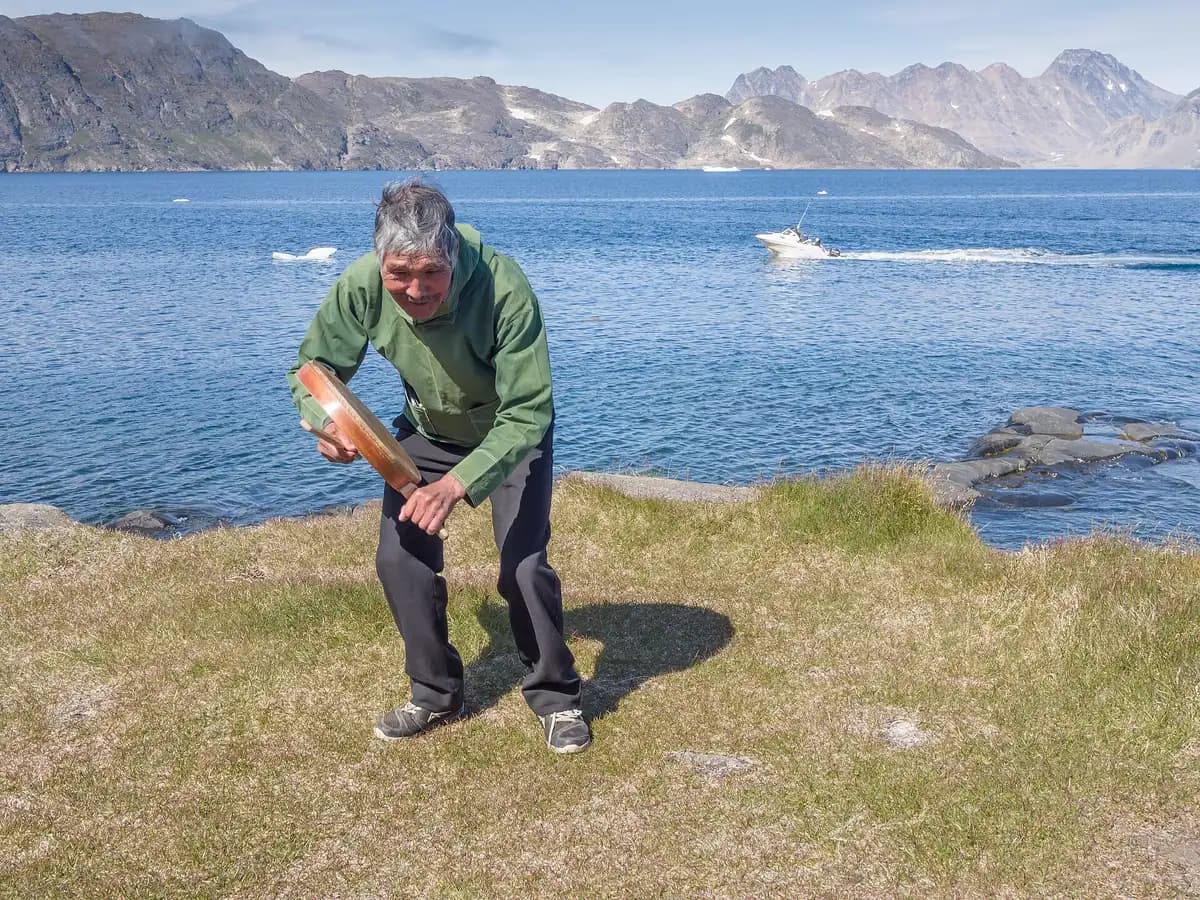
Largely outside this page, which is a popular-music route. Greenlandic drum dance and drum song, performed on an oval frame drum, are the oldest musical practice on the island and were suppressed under missionary rule before being revived in the twentieth century. Piseq, personal songs about daily life, and katajjaq-style vocal games belong to the same world. These traditions are documented and performed but rarely enter the dated commercial catalogue that a page like this is built from.
Sources & References
- 1Music of Greenland — Wikipedia contributors, 2026
- 2Sumé and the Greenlandification of popular music — Greenlandic Popular Music, 2021
- 3From anti-imperialism to existentialism — Greenlandic Popular Music, 2021
- 4Music in Greenland — Visit Greenland, 2024
- 5Julie Berthelsen — Wikipedia contributors, 2026
- 6Rasmus Lyberth — Wikipedia contributors, 2026
Further Reading
About This Article
This page is based on documented music history, label catalogues and artist biographies. Release years come from label credits and distributor metadata rather than from video upload dates. Every linked recording was checked against the uploading channel and confirmed playable before publication.
Curated by the timeline.music editorial team.
▸Read the timeline as text
The sound of Greenland, decade by decade: 6 genres and 18 artists, from the 1970s to the 2020s.
- 1970s
- Greenlandic Rock with Sumé; Greenlandic Folk and Songwriting with Rasmus Lyberth.
- 1980s
- Greenlandic Rock with Zikaza; Greenlandic Folk and Songwriting with Rasmus Lyberth and Ole Kristiansen; Greenlandic Hip-Hop with Nuuk Posse.
- 1990s
- Greenlandic Rock with Zikaza and Chilly Friday; Greenlandic Folk and Songwriting with Rasmus Lyberth and Ole Kristiansen; Greenlandic Hip-Hop with Nuuk Posse.
- 2000s
- Greenlandic Rock with Chilly Friday and Nanook; Greenlandic Folk and Songwriting with Rasmus Lyberth, Ole Kristiansen and Aavaat; Greenlandic Hip-Hop with Nuuk Posse and Peand-eL; Greenlandic Pop with Julie Berthelsen and Kimmernaq; Greenlandic Indie with Nive Nielsen & The Deer Children and Simon Lynge.
- 2010s
- Greenlandic Rock with Nanook; Greenlandic Folk and Songwriting with Rasmus Lyberth; Greenlandic Hip-Hop with Peand-eL and Tarrak; Greenlandic Pop with Julie Berthelsen and Kimmernaq; Greenlandic Indie with Nive Nielsen & The Deer Children, Simon Lynge and Small Time Giants.
- 2020s
- Greenlandic Rock with Zikaza and Nanook; Greenlandic Hip-Hop with Tarrak; Greenlandic Pop with Naja P; Greenlandic Indie with Nive Nielsen & The Deer Children, Simon Lynge and Small Time Giants; Greenlandic Electronic with Andachan and Ivaana.